

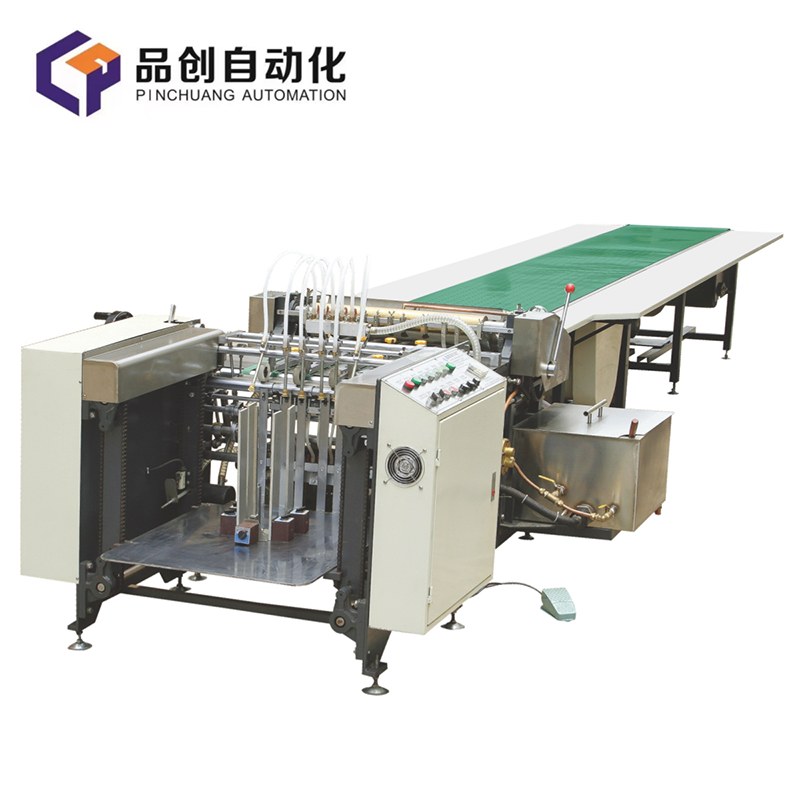
An automatic paper gluing machine applies an even adhesive film across a printed sheet before it is wrapped onto board. It is the station that quietly decides whether a wrap clings flat or bubbles, lifts at the corner or peels months later in a warehouse. Glue is the least discussed and most common cause of rigid box quality complaints, and almost all of it traces back to film consistency rather than to the adhesive itself.
At Pinchuang, we have been manufacturing rigid box and case making equipment in Dongguan since 2008, and gluing faults are the most frequent reason customers send us a rejected box for diagnosis. This guide explains why film consistency matters more than glue type, how the machine controls it, the three faults that account for most rejects, and how to match gluing settings to the board and wrap you actually run.
Why Glue Consistency Decides Wrap Quality
The wrap is bonded to the board across its entire surface. Where the adhesive film is even, the bond is uniform and the paper lies flat. Where the film is thin or missing, the paper is only held around the edges, and it moves.
That movement shows up in three ways. Bubbles appear where a thin patch of glue lets the paper lift away from the board. Lifting corners appear where the film ran out at the edge of the sheet, because corners are the first place a wrap is stressed. Curling and warping appear when the paper absorbs more moisture on one side than the other, which an uneven glue film makes worse. All three look like different problems on the customer's bench and all three come from the same station.
This is why an automatic paper gluing machine is worth buying before almost any other upgrade. A forming station compresses a problem the glue created; only the gluing station prevents it.
On our gluing platform the working range covers paper from 80 to 200 g/m² and widths from 80 to 600 mm, with a gluing speed of 7–40 units per minute. Those three figures define what the machine is for: light decorative wraps fed as flat sheets, not heavy board.
Glue Film Control: Rollers, Doctor Blade and Viscosity
Three mechanisms work together to put an even film on the sheet, and understanding which one is out of adjustment saves a lot of trial and error.
1. Rollers
The glue roller picks up adhesive and transfers it to the sheet. Roller pressure and surface condition decide how much transfers and how evenly. A roller that is worn, glazed or set with uneven pressure across its width will produce a film that is thick on one side and thin on the other — and the resulting box will have lifting corners on exactly one edge.
2. Doctor blade
The doctor blade scrapes excess adhesive off the roller to set the film thickness. It is the setting most often adjusted and the one most often over-adjusted. A film that is too thick soaks the paper and causes it to stretch and wrinkle during wrapping; a film that is too thin leaves dry patches. The right setting produces a film you can see as an even sheen across the whole sheet, with no dry areas and no visible excess.
3. Viscosity and temperature
Adhesive viscosity changes with temperature, and it changes between batches of the same product. A setting that works on a warm afternoon will apply a different film the next morning if the workshop is cold. This is why glue checks at the start of a shift are worth more than any single machine adjustment, and why our gluing configuration includes a heated circuit — 4 kW on the current model — to keep the adhesive behaviour stable through the day.
Three Common Gluing Faults and Their Causes
Almost every gluing complaint we are asked about falls into one of three categories. The table maps the symptom to the likely cause so you can stop adjusting the wrong thing.
| Fault | Most likely cause | First thing to check |
|---|---|---|
| Bubbles under the wrap | Thin or missing adhesive in patches | Doctor blade setting and roller condition |
| Lifting corners or edges | Film running out at the sheet edge | Roller alignment across the full sheet width |
| Wrinkles and stretching in the wrap | Film too thick, paper soaking up adhesive | Doctor blade setting, then paper weight |
| Fault changes through the day | Viscosity drifting with workshop temperature | Glue temperature and shift-start viscosity check |
| Fault appears only on one product | Settings transferred between different paper weights | Whether this paper has its own setting record |
The last two rows are the ones that cost plants the most time. Both are process failures rather than machine failures, and both are solved by record-keeping rather than by adjustment. A simple sheet listing paper weight, glue type and blade setting for each product will remove more faults than any upgrade.
Matching an Automatic Paper Gluing Machine to Board and Wrap
Gluing cannot be set in isolation. Three properties of the material in front of you change what the correct film looks like.
- Paper weight. Light decorative papers under about 120 g/m² soak up adhesive quickly and will cockle if the film is too heavy. Heavier textured papers need more adhesive to bond to a rigid board, because their surface is uneven. On our platform the range covers 80–200 g/m², and each end of that range wants its own setting.
- Surface finish. Coated, laminated and foil-stamped papers do not absorb adhesive the way uncoated paper does, so the film behaves differently even at the same weight. A laminated wrap that lifts is usually an absorption problem rather than a glue quantity problem.
- Board surface. Greyboard is absorbent and slightly rough, which helps the bond. If a board batch arrives with a smoother or dustier surface than usual, adhesion changes without any setting being touched. This is worth checking when a fault appears with a new pallet of board rather than after a settings change.
One practical rule covers most of it: whenever the wrap changes, re-check the film before running the order. The check takes a single sheet and a minute, and it prevents the most expensive kind of reject — one discovered after the boxes have already been formed, corner pasted and packed. A corner pasting station downstream will not tell you that the glue was wrong.
Where Gluing Sits in the Line
Gluing normally runs immediately before wrapping, and after grooving. It feeds a forming station or a wrapping unit, and on a case making line it feeds the board placement and edge turning operations.
Throughput rarely becomes an issue here, because a gluing machine rated at 7–40 units per minute sits comfortably alongside the rest of a standard line. What does become an issue is the working width. Our gluing platform covers paper widths from 80 to 600 mm; if a plant starts taking orders for larger box lids or wider case covers, the gluing station becomes the constraint before any other machine does. Check the width against your largest product, not your average one.
For scale reference, Pinchuang builds this equipment in a 10,000 m² facility in Dongguan with more than 100 employees, and the machines ship to over 30 countries. We have been manufacturing rigid box equipment since 2008, and we exhibit at All in Print China, Printing South China, China Print, Drupa, SINO FOLDING CARTON and WEPACK.

If glue faults keep returning, the fastest route to an answer is a sample rather than a conversation. Send us a sheet with the film applied and a rejected box, and the pattern of the fault usually identifies the setting within minutes. Looking at the applications we see most often can also tell you quickly which wrap types your own order book will demand.
Common Questions About Paper Gluing
Should I change glue or change the setting?
Change the setting first. Most gluing faults come from film thickness and distribution rather than from the adhesive itself, and switching glue types without correcting the film simply moves the problem. Adjust the doctor blade and confirm roller alignment before considering a different adhesive.
Why do my boxes bubble only in summer?
Temperature changes adhesive viscosity, and in a warm workshop the adhesive flows differently and the paper absorbs moisture differently. A heated glue circuit and a shift-start viscosity check remove most of that seasonal variation. If the fault is genuinely seasonal, it is a process condition rather than a machine fault.
How thick should the glue film be?
Thin and even beats thick and uneven every time. A film that shows a uniform sheen across the sheet, with no dry patches and no wet excess, is correct for most decorative wraps. If the paper is stretching or cockling, the film is too heavy regardless of what the setting says.
Can one gluing machine handle every paper in the plant?
Our gluing platform covers 80–200 g/m² and widths of 80–600 mm, which covers most decorative wraps used in rigid box and case making. What it will not do is run two different papers at one setting. Treat every paper weight and finish as its own setup and keep the settings on record.
Send Pinchuang a glued sheet and a rejected box, plus your paper weight and roller width. We will identify which automatic paper gluing machine setting your wrap needs, and whether the fault belongs to the glue or to a station downstream.
Send us a glued sheet Compare gluing configurations